CT still experiencing harsh turbulences
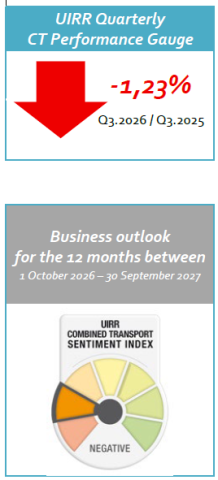
Over the past three months, the economic environment for Combined Transport has deteriorated further, recording volumes falling by 1,23% compared to the third quarter of 2025. While several members still see some positive prospects, the overall European environment does not leave much room for optimism in the short term.
The problems encountered are well known: infrastructure challenges, with German transport corridors only running at minimum capacity; extremely low water levels on the Rhine, leading to disruptions that also hit terminals; subpar alternative routes; and increasing track access charges. All of this coming on top of a negative economic environment, with low growth and high inflation.
Infrastructure remains the main challenge, mostly in Germany, where DB has acknowledged that the roll-out of the Generalsanierung was either too ambitious or not properly thought through. The Hannover to Berlin diversion is a perfect case in point. The diversion plan had to be redesigned because the original alternative line will not be electrified before December 2027, well after the renovation work started on 2 October 2026.
Track access charges in Germany are still set to rise by around 12% in 2027. This sharp increase will be overshadowed by the track access charges in 2028 set to increase by +85% for very heavy trains and +6.6% for regular trains. UIRR will assess the impact of these track access charges hikes on its members and the business, and will react accordingly. UIRR continues to claim compensations for subpar alternative routes proposed within the Generalsanierung.
On the legislative side, the EU Commission does not seem to be conscious of the urgency of reviving rail freight, as hinted at by Transport Commissioner Apostolos Tzitzikostas in his response to MEP Ondřej Krutílek’s letter (see below). This sentiment also comes in a context where the concerns of the sector have not been entirely considered regarding the Swiss NSA’s wheelset requirements, despite a JNS suggesting a way forward. To change this trend, UIRR is actively promoting the elaboration of a cross-border freight strategy by the Commission that would serve as a blueprint for a future-proof, rebalanced European transport system in which intermodal transport gets a more prominent space. We acknowledge the Commission’s goodwill, as evidenced by ERA’s recognition that there is room for improvements in the execution of certain laws. Notably, the agency recognised that the fragmented roll-out of ERTMS has complexified the situation, and better implementation could have avoided this.
On the sector side, not all is lost. Solutions are emerging as the need for resilience is increasingly recognised. Investments are coming in, and operational innovations and trials show that the sector is not standing still. In Spain, for example, a steady flow of investment is already producing visible effects. In France, a good momentum continues to take shape while other countries recognise the importance of rail and intermodal freight in both the European transport system and its defence architecture. However, based on the sentiment reported by UIRR members, the Business Sentiment Index of the European Combined Transport Community is negative for the next twelve months.
The UIRR Galaxy has just expanded by welcoming OLTIS Group and Hit Rail as new partners!
Ralf-Charley Schultze
Director General